



By Charles Morgan and Hubert Walker for CoinWeek Notes …..
The 1943 Lincoln Steel Cent was the result of the United States Mint’s efforts to conserve strategically important metals during World War II by replacing the copper used in cent production with zinc-plated steel. The appearance of these steel cents is markedly different from that of the typical copper penny, making this one-year coin a favorite amongst coin collectors and those who collect interesting novelty items.
To understand why these coins were made, one must understand the pressures that the United States was under to manufacture sufficient weapons and munitions to wage global war against the Axis. As the continental United States had not been subject to the kind of daily bombardment that befell our European allies, America’s industrial might was charged with not only supplying the U.S. Armed Forces but also the militaries of England, Russia, and more.
To do this, the country needed to conserve its mineral resources. The Roosevelt Administration understood this, and even before Japan’s surprise attack on Pearl Harbor on December 7, 1941, an analysis of America’s mining output revealed that the Government would need to explore striking coins from alternate metals to make better use of nickel and copper.
Experiments to Find A Solution to the Wartime Copper Shortage
Starting in 1941 and continuing into late 1942, the Philadelphia Mint and the branch mints at Denver and San Francisco carried out a series of experiments to find a suitable short-term replacement for the bronze alloy used to strike the cent. Private companies like DuPont, Monsanto, the Blue Ridge Glass Corporation, and Tennessee Eastman were contracted to carry out experiments, as well. The Federal Government learned much about alternative planchet compositions in a process that yielded some strange and impractical pattern coins, many of which are quite rare today.
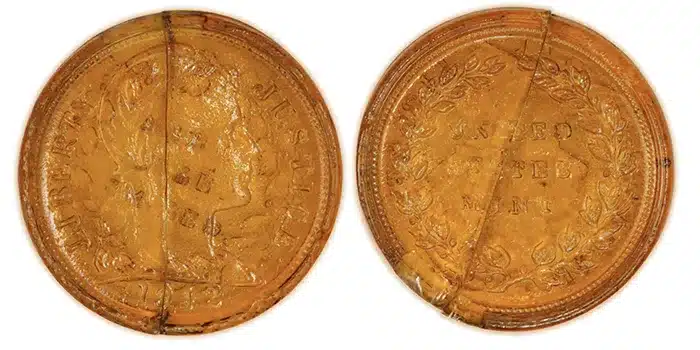
By the fall of 1942, the Mint had narrowed its experimental focus to zinc-plated steel. Chemist Henry Brown is credited with developing the zinc finish. On December 18, 1942, Congress passed legislation authorizing the Mint to produce one-cent coins out of alternate materials. In January, the Mint released a two-page document outlining the specifications for the steel cent. These specifications called for common SAE1010 steel with a thin electroplated layer of zinc to slow down the rust to which the steel was susceptible.
Production of the 1943 Lincoln Steel Cent began on February 27, 1943, and continued to the end of the calendar year.
The Changing Appearance of the 1943 Lincoln Steel Cent
When new, zinc-coated steel cents have a bright white appearance. Given their similarity in size and appearance, it’s not unlikely that the 1943 steel cent was sometimes mistaken for a dime upon its release. This confusion would not have been an enduring concern, however, as these coins lose this initial appearance after some exposure to the elements. Circulated 1943 Lincoln Steel Cents often exhibit a dull, dark, or mottled appearance caused by the breakdown of the thin zinc layer and the onset of rust on the steel planchet.
While unusual as a one-year issue, coin collectors are interested only in bright white uncirculated coins. Unfortunately, some coins sold in the mass market have been re-plated to appear new. These coins are fairly easy to detect, as their surfaces lack original mint luster and look to be “dipped” in a silver coating or “painted over”.
Not All 1943 Lincoln Cents Were Struck on Zinc-Plated Steel (Oops!)
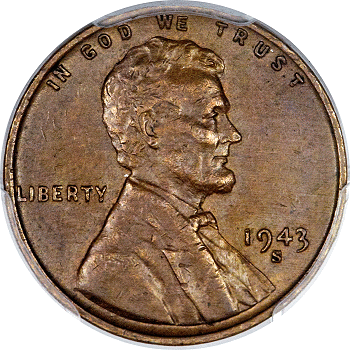
While the Mint intended to strike cents only on zinc-plated steel planchets in 1943, not quite two dozen coins struck on unused bronze planchets were produced. These coins are major rarities and have a fascinating story to tell.
Similarly, some unused steel planchets were also used in manufacturing 1944 cents (at all three Mint facilities) after the transition back to a bronze composition. The 1944 steel cents are quite rare, but they don’t have the cachet of the 1943 coppers.
For years, the unsuspecting have been deceived by copper-coated steel 1943 cents – though a simple magnet test easily exposes the fakes. More sophisticated counterfeits have been made on genuine copper cents of other dates or on copper blanks. In a presumed instance of a “good marketing idea gone bad”, a New York coin company plated 5,000 steel cents with copper in the early 1960s and released them into circulation. For several months afterward, dealers received calls from those believing they had found a true rarity.
The 1943 Lincoln Steel Cent: A Popularly Collected Coin with Some Value
Being such an unusual coin, the 1943 Lincoln Steel Cent was saved in large quantities. Fresh coins with attractive surfaces in high uncirculated grades are typically traded after being certified by a third-party grading service like CAC, NGC, or PCGS. In Gem Mint State grades, these coins sell for about $30 each. It is worth noting that this is also roughly the cost of having the coin graded.
In Superb Gem grades of MS67 or MS68, 1943 Lincoln Steel Cents trade at auction for hundreds and even thousands of dollars.
Charmy Harker Discusses the 1943 Lincoln Steel Cent
* * *
Market Data and Noteworthy Specimens

Since September 2024, the CAC MS68 population has risen from 40 stickered and none-graded to 43 stickered and one-graded. Over the same period, the PCGS and NGC MS68+ populations remained unchanged. The price differential between a PCGS MS68+ and an NGC MS68+ stands at a staggering 10×1.
Top Population: PCGS MS68+ (3, 9/2025), NGC MS68+ (7, 9/2025), and CAC MS68 (43:1 stickered:graded, 9/2025).
- NGC MS68+ #6821071-010: GreatCollections, February 9, 2025, Lot 863409 – View.
- PCGS MS68+ CAC #39139782: GreatCollections, December 13, 2020, Lot 865696 – View; GreatCollections, November 17, 2024, Lot 1575593 – $32,374.12. Pop 3 when offered.
- PCGS MS68+ CAC #39803108: Stack’s Bowers, November 13, 2020, Lot 9083 – $33,600. Pop 2 when offered.
- PCGS MS68+ CAC #36518298: “The Neon Lights Collection,” GreatCollections, November 29, 2020, Lot 916035 – View.
- NGC MS68+ CAC #6072828-001: GreatCollections, March 3, 2024, Lot 882556 – View.
- PCGS MS68 #70000131: Stack’s Bowers, June 24, 2025, Lot 1391 – $3,360.
- PCGS MS68 #43190781: Heritage Auctions, May 1, 2024, Lot 3445 – $3,360.
- PCGS MS68 CAC #48044222: Heritage Auctions, May 9, 2024, Lot 3907 – $4,560.
- PCGS MS68 CAC #07893907: “The Bender Family Collection – Post-1932 Lincoln Cents,” Heritage Auctions, December 15, 2022, Lot 3328 – $7,200. Bender Collection on insert.
- PCGS MS68 CAC #36056656: Stack’s Bowers, August 16, 2021, Lot 1224 – $4,080.
* * *
Design
Obverse:
The iconic portrait of beloved 16th president Abraham Lincoln faces right. Wrapping around the inside of the rim, above Lincoln’s head, is the motto: IN GOD WE TRUST. To the left of Lincoln’s portrait is the word LIBERTY, and to the right and slightly lower is the date. Cents produced for 1918 and subsequent years have the designer’s initials V.D.B. on the bottom bevel of Lincoln’s shoulder.
Reverse:
The reverse has a prominent display of the denomination ONE CENT at the top center, each word on a separate line, and below that the inscription UNITED STATES OF AMERICA in two lines. The motto E PLURIBUS UNUM, with a center dot between the words, arcs along the top inside a raised rim. To both the left and right of the center text (curved to follow the rim), are stylized images of the seed head of wheat, called “wheat ears” by many, and the source for the type name.
Edge:
The edge of all Lincoln cents is plain or smooth, without reeding or edge lettering.
Specifications
| Lincoln Wheat Cent | |
| Year of Issue: | 1943 |
| Mintage: | 684,628,670) |
| Alloy: | Low-carbon steel coated with 0.005″ layer of zinc |
| Weight: | 2.7 g |
| Diameter: | 19.0 mm |
| Edge: | Plain |
| OBV Designer: | Victor D. Brenner |
| REV Designer: | Victor D. Brenner |
* * *
Additional References
Bowers, Q. David. The Experts Guide to Collecting and Investing in Rare Coins. Whitman Publishing.
–. A Guide Book of Lincoln Cents. Whitman Publishing.
–. A Guide Book of United States Type Coins. Whitman Publishing.
Burdette, Roger. United States Pattern & Experimental Pieces of WW-II. Seneca Mills Press.
Feigenbaum, David Lawrence and John Feigenbaum. The Complete Guide to Certified Barber Coinage. DLRC Press.
Guth, Ron, and Jeff Garrett. United States Coinage: A Study by Type. Whitman Publishing.
Lange, David W. The Complete Guide to Lincoln Cents. Zyrus Press.
Yeoman, R.S., and Kenneth Bressett (editor). The Official Red Book: A Guide Book of United States Coins. Whitman Publishing.
* * *




The weight and thickness of the coating is off by a noticeable amount.
The zinc coating’s thickness is 0.0005″, and weighs 42.5 grains or 2.753954 grams, as reported by the US Mint directly in their annual report in 1944.
I have a couple of the stess penny from 1943 how can I sell them?
Guillermo Sanchez As the article notes, collectors are only interested in high-quality 1943 cents that exhibit little or no wear. If your coin was taken from circulation and shows a gray or leaden color it’s not going to retail for more than a dollar, and any dealer will have more than they need. You might keep the coin as a conversation piece or use it to raise a young collector’s interest, as a memento of a time when even the lowly penny made a sacrifice for the war effort.
I have three pennies 1943 and they r silver or steel I don’t know which but would love to find out and how fo I go bout that plus I have other coins from other countries just wondering how or what to do with them and I have dollar bills from Canada and two other countries what or how to do I find out what they worth thanks
@Christie Lynn As the article explains the coins have a silver _color_ when new but they’re made of steel. Remember that cents are larger than dimes – it would not have made “cents” for the mint to issue a silver penny that was worth more than a ten-cent piece.
Today a 1943 steel cent in average condition will retail for anywhere between 25¢ and a dollar.
I have a 1943 wheat silver steel penny where can I take it to see the amount it’s worth
@Luerether Dejean As the Specifications section explains, your cent is steel rather than silver. After all if it had been made of silver it would have been worth more than a dime! In any case if your coin is in average circulated condition with a grayish surface it’s probably only worth 25 cents to a dollar. Also as noted in the article, large numbers of steel cents were saved as keepsakes so they are not rare.
Yes I also have a 1943 steel penny what is it’s value? It’s in good condition thank for networking with me
I have one two
@Thomas Lee As explained in the article, only top-quality steel cents are of interest to collectors. If your coin shows wear or discoloration it’s likely to be worth no more than a dollar, and likely less. My advice would be to keep it as a conversation piece or give it to a young collector who may not have found one for their collection.
You have to get it graded
Good morning, I’m not a collector but I have a few coins that caught my attention. I entered an app that gives me the grade of the coins and all the complete information. My attention was when I checked 2 of the coins, which are 1943 wheat Lincoln, the reference price of one says $0.26 and the other says very Fine the reference price $0.26/ $93750 and a lot of data the Mintage 684628670 Composition Zinc plated Steel and the Designer Victor David Brenner (VDB) if anyone knows about this can you explain to me what it is about.
@Raquel B My suggestion for anyone new to collecting would be to find a copy of the famed “Red Book” Guide Book of United States Coins. It offers straightforward histories, minatage and value figues, and images of nearly all US coins.
To answer your specific questions, the article gives an explanation of the coin’s composition and the work of its designer Victor David Brenner. You didn’t state your coin’s mint mark (or lack of it). However the 684,628,670 mintage figure corresponds to the output from Philadelphia which doesn’t put a P mint mark on its 1¢ pieces even today. As such your coin is pretty common and doesn’t carry much of a premium. THe $0.26 price is typical for a well-circulated one. Without more information I can’t say where the $93,750 figure comes from, but it it almost certainly corresponds to either an extremely high quality coin or to one of the bronze error pieces that are also explained in the article.
saludos tenbo un centavo del 1943 serie D Steel Lincoln Head cent UsB -02 cual seria el valor del mismo , gracias
@Nilsa Sierra El valor de su moneda depende de su desgaste. Los precios promedio de un centavo de acero en circulación oscilan entre 25 centavos de dólar estadounidense y 1 dólar.
Para explicar la D, no es una letra de serie. Se llama marca de ceca e indica que la moneda fue acuñada por la Casa de la Moneda de Denver.
I got 1943 no mint in perfect condition
I have 9 1943 and 1944 weat pennies I would like to know what there worth
@Jason Assuming they’re* in circulated condition, the steel ones would be worth only 25¢ to $1 and the 1944 coins would be worth 5¢ to 75¢.
(*) To clearify, I believe you mean “they’re” and “wheat”
Great article on the 1943 Lincoln Steel cent.
The 1943 Lincoln Steel Cent is a great coin!
I love collecting steelies. Awesome article.
I have a penny that has the year 199 and where it says Liberty it only says iberty ion it.. nevertheless I have pennies ranging from 1902 all the way to present I got a lot of 1919 I got 19 18 19 16 19 I got 1900 pennies year pennies in which I’m trying to sell because I or find out if they even worth anything because I have no use for them and I’d Rather somebody that was interested in pennies and collectibles to have more use for them than I can not to mention I have three 1943 steel pennies I don’t know if that’s even worth more than a dollar or fifty cents that people claim but if they’re not more than 50 cents then I’m not getting rid of them but I greatly appreciate somebody that who is and might be interested in the pennies that I do have which is about a nice 200 or 300 of them will give me some nice amount of money for them I’d be willing to do something I greatly appreciate it if you can contact me back
Great article! I found the history of the 1943 Lincoln Steel Cents fascinating, especially the reasons behind the switch to steel during WWII. It’s amazing how a small piece of change can carry so much history. I’m curious about how the value of these coins has changed over the years—do you think they will continue to appreciate?
Great article! I had no idea about the history behind the steel cents. It’s fascinating to see how they were produced during wartime and their significance today. I’m definitely going to keep an eye out for these in my collection!