


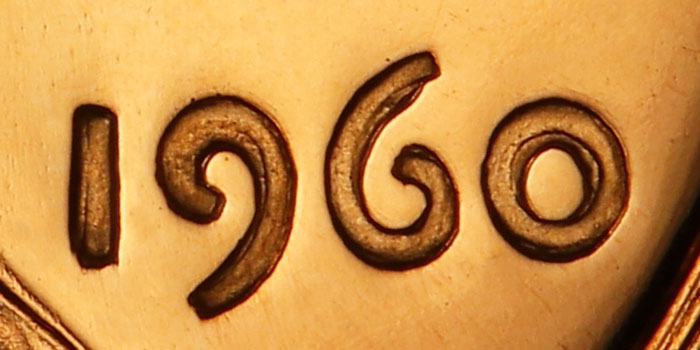
As the much-missed numismatist David Lange wrote in his excellent CoinWeek article, 1960 was a pivotal year for coin collecting in the United States.
Rare coins, the traditional backbone of the hobby, continued to thrive, with many historic collections being built – some publicly, some privately. But the real buzz encircling the coin hobby centered on modern United States Mint issues. Collector interest in annual Proof Sets was growing year after year. A market for uncirculated coin rolls had developed, with speculators placing bets that desirable Mint State coins had a bright future as the hobby’s expansion continued to grow at a double-digit pace year-after-year.
But none of this compares to the buzz the developed when the Mint carried out the seemingly innocuous act of changing the date style of the Lincoln cent in March of that year.
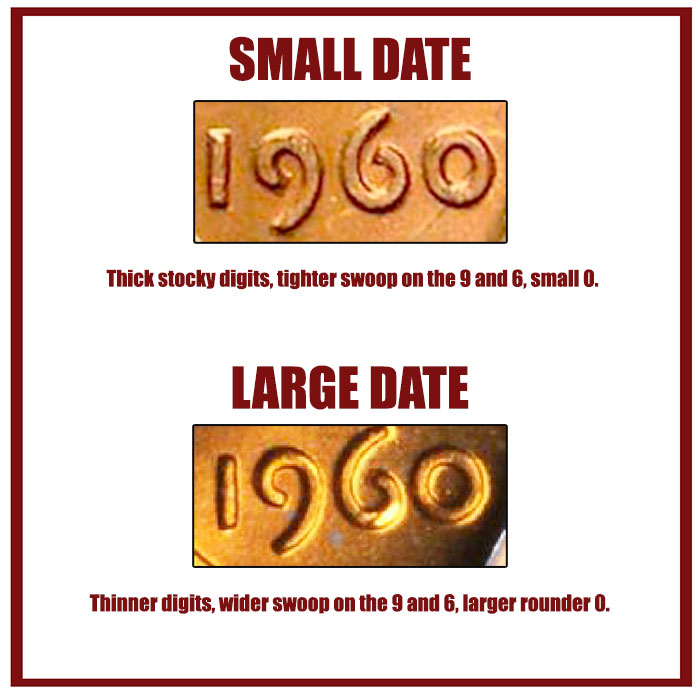
At the outset, the Mint produced coins using a smaller font for the date. This date style (the “Small Date” variety) is easily identifiable and is comprised of thick stocky digits, tight swoops on the 9 and the 6, and a small 0.
Fearful that the size of the 0 might clog dies and cause unnecessary work, the Mint deployed a completely redone date style with larger numerals. The “Large Date” variety features wider swoops on the 9 and the 6, a large round 0, and is thinner than the small date style.
A majority of the 586 million circulation strike cents struck at Philadelphia and the 1.58 billion circulation strike cents struck at Denver are of the large date variety. Small Date output is believed to have taken place in January through early March at the latest, although the Mint has provided no specific mintage figures that delineate the two date styles.
In January, Philadelphia struck 2,075,000 cents while Denver struck 73,450,000. In February, only Denver struck cents, striking 168,790,000. In March, cent production resumed at Philadelphia, with 36,440,000 struck there, while Denver continued to pour out one-cent coins to the tune of 111,480,000 pieces.
Despite this massive disparity in production runs, Small Date cents from Philadelphia and Denver trade for roughly the same amount of money in today’s market. The availability of this issue in single and roll form leads us to believe that while the 1960 and 1960-D Small Date coinage is not rare, much fewer were struck than their large date counterparts.
Proof issues also feature Large and Small Date varieties.
It is widely believed that the entirety of the Proof Set mintage made in January and February are of the Small Date variety. This accounts for 65,114 sets made in January and 145,711 sets made in February. The Mint filled 1,691,602 Proof Set orders in 1960, which means that Small Date cents account for approximately 12% of all 1960 Proof cents struck. As such, 1960 Small Date Proof cents trade for about double the price of their Large Date siblings. A recently graded example in PCGS PR68CAM sold at an October 2020 Heritage auction for $228.
Note: 1960 Lincoln Small Date cents are scarce with Cameo frost in any grade above PR68 and are scarce in any grade with Deep Cameo frosting.
Even rarer are two elusive 1960 Proof varieties that are struck from dies that were impressed by two separate hubs, one hub with the Small Date and the other with the Large Date. The order in which these hubs were deployed on the working die determines whether the variety is the Small Date over Large Date or the Large Date over Small.

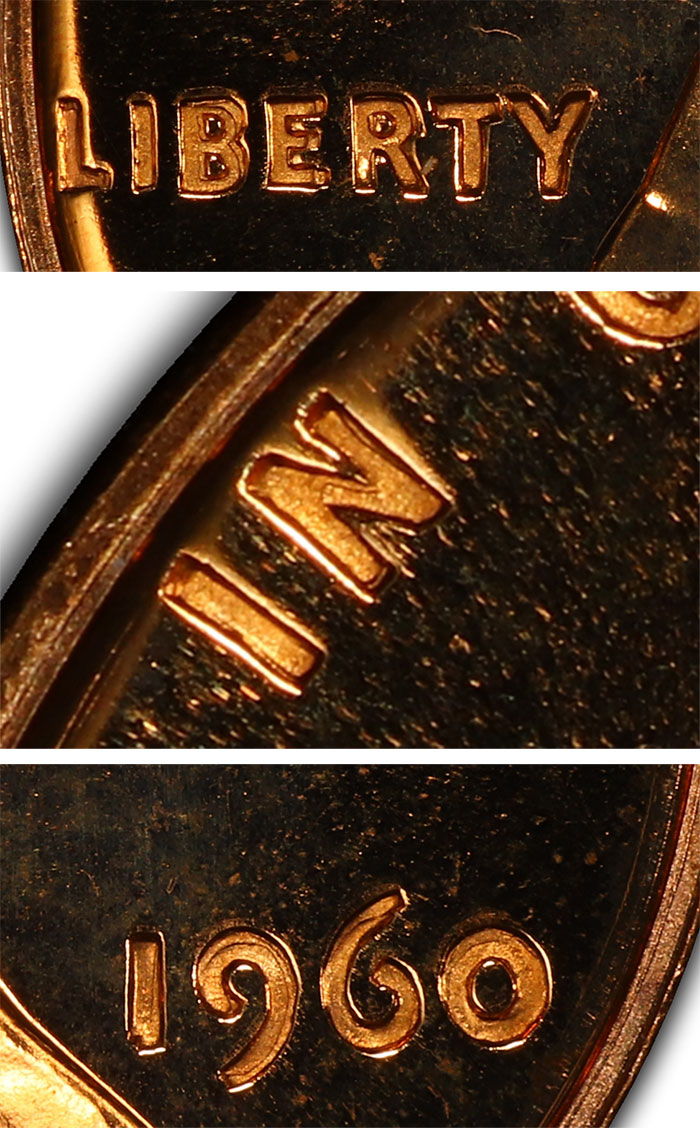
Diagnostics for the 1960 Small Date Over Large Date are easy to identify. Starting at the date, you will see a prominent notch to the left of the 1, small curvilinear impressions of a 9 and 6 over those digits, and what appears like a small donut-shaped 0 over the larger 0.

The Large Date over Small Date variety also shows misaligned LIBERTY, most prominently displayed on BERTY. The date shows both date styles, but you will see that the thinner date style is superimposed over the small date style. The Large 9 and 6 extend over the small 9 and 6. The large 0 reveals the smaller 0 shape on the inside of the digit.
Collecting 1960 Large Date Over Small Date & Small Date Over Large Date Proofs
Both 1960 Large Date Over Small Date & Small Date Over Large Date Proof varieties represent a challenge for collectors and cherry pickers. This family of varieties was first discussed in Coin World’s “Collectors Clearing House” in February and March 1966 and has been popular with variety hunters ever since. Your best chance to find one of these varieties in the wild is by searching through one-owner Proof Sets. Getting ready access to material like that is more likely to happen if you operate a retail coin shop. Assume that most Proof Sets that cycled through the system have been searched through as the Small Date variety is obvious to even non-specialist dealers and brings a premium.
Given that these overdate varieties require the large date, you can eliminate the need to look through Small Date sets.
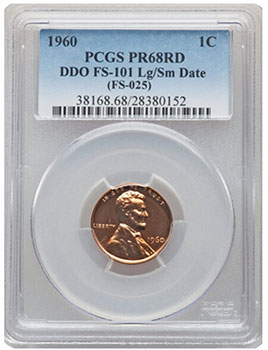
In certified holders, both varieties carry a significant premium. In Proof 65, both varieties trade for $160 and up. We recommend that the collector pay the slight premium necessary and consider examples in the grade of PR67 or PR68. Examples with Cameo contrast are rare and command a significant premium over the price of Proof examples with a brilliant finish. High grade examples of each of these with Cameo contrast trade infrequently and based on the results from two examples that sold at GreatCollections in 2014, we expect attractive examples to command prices between $1,500 and $2,000 in today’s market.
Obverse:
The obverse of the 1960 Lincoln cent was designed by Victor David Brenner and appears largely as it did when the type was first minted in 1909. The main difference on the 1960 obverse versus the 1909 version is the location of Brenners’ initials, V.D.B., which were added under Lincoln’s bust in 1918 after their removal from the reverse in late 1909. The date, 1960, appears to the right of Lincoln, and the national motto IN GOD WE TRUST appears above the president. On the left of the 16th president is the word LIBERTY.
Reverse:
Frank Gasparro designed the 1959 Lincoln Memorial reverse that replaced the original 1909 Brenner wheat stalk design. Gasparro’s initials FG appear on the lower-right side of the Lincoln Memorial. Below the edifice and along the rim are the words ONE CENT, while the legend UNITED STATES OF AMERICA run along the top half of the reverse along the rim. Between the top of the Lincoln Memorial and UNITED STATES OF AMERICA inscription is the motto E PLURIBUS UNUM.
Edge:
The edge of the 1960 Lincoln cent is plain or smooth, without reeding or lettering.
1960 Lincoln Cent Designers
Lithuanian-born coin designer Victor David Brenner is best known for his iconic design for the Lincoln cent (1909-Present) (View Designer’s Profile).
Frank Gasparro was an American medalist and coin designer (View Designer’s Profile).
Coin Specifications
| Country: | USA |
| Year Of Issue: | 1960 |
| Denomination: | One Cent |
| Mint Mark: | None |
| Mintage: | Less that 10,000 (CoinWeek estimate) |
| Alloy: | 95% copper, %5 tin and zinc |
| Weight: | 3.11 g |
| Diameter: | 19.05 mm |
| Edge: | Plain |
| OBV Designer | Victor David Brenner |
| REV Designer | Frank Gasparro |
| Quality: | Proof |





I have a 1960 penny
Who do I contact if I have a rare coin?
First have it authenticated. Send for grading and contact a leader in auctions like Heritage or Stack’s. Good luck.
Who do I contact about a rare coin
I have the same 1960D over the top of D mint mark the exact same one that’s on the Lincoln penny book it has all the same nicks and marks and double die on date the exact same one
Soʻ cool. Thanks for explaining
I have a super rare 1960 D Lincoln ONE CENT
obverse and reverse super deep ridge setting while all the surface of this amazingly mirror appearing coin seems to be emitting reflections of brilliance of it’s own , super imposed cameo , fore- say, while the weight is 3.6 gram just what may this be?
I have a rare great condition 1960 6 is substantially higher than rest with small D mint and in LIBERTY the L and the I are messed up from press who can I contact about this
Good tips on identifying the overdates!
Looks like I am going to be busy checking my pennies this week! Thank you for the tips
Always love to read articles about Lincoln cents! This was very informative, as I had no idea about the double strikes. Thanks!
Its so hard to tell the difference in a circulated one.
Never knew this, gotta check my proof sets
I have some heavily circulated examples.
The year I was born!
Nice article.
I always question myself when looking at years which is small and which is large. This article was a great help with that
boy i wish ihad one i have some old coins
Thank you for all the info you give to the collectors.
Very interesting article !
Beautiful. Guess I’ll have to check mine
Great Article! Thank you!
I have three large gallon glass apple juice jars full of pennies. I really need to spend some time and go through them.
Interesting
Great insight about differences between 1960 cents.
That’s why I love coin collecting there’s so many different varieties and things to look for
Fascinating. I did not know about small date/large date and large date/small date overstrikes.
Something else to look for as I sort my coins during the upcoming (supposed to be colder and snowier here) winter
1960 Lincolns are very unique.
I have a rolls of 1960D LG date still in original bank wrappers. I wonder if I should check them?
Interesting
I remember looking for these when I was a kid and could actually see the dates
Excellent article!! Just when I thought I knew all there was to know about the 1960 Lg and Sm date varieties. I have some rolls of both… might have to crack one open and see what gems may be hiding inside!!
interesting information and facts to be aware of. Thank you.
Appreciate the visual showing the difference between the large and small date.
I have to get a digital microscope
great tips for going thru my $50.00 worth of 1960 pennies I collected in the 60s
Informative and interesting article!
Unfortunately, I just don’t have the eyes to pick these out, but I everyone older than 1982 anyway and maybe someday I’ll have the magnifiers I need to tease apart the valuable coins from just the copper ones!
I like the tips but I still have a hard time telling the difference.
Excellent article. I will have to take a closer look at my 1960 proof sets.
Great article I think I have a few of these
Great article I think I have a few of these the small dates nice to know
It never ceases to amaze me how many varieties there are for the humble Lincoln cent.
I’m not sure still about the slight difference. Is it that important of slight changes that make or break a coin value? If I had to spend hours staring through a magnifying glass I’d go blind and my wife would hit me on the head with it because I’ll get nothing done around the house. I’ll go for buying a mid range grade to fill the hole in the collection and save my noggin.
Great article. It filled in a few gaps I had about the 1960 cent. The fun part for me is the searching. My wife can tell when I find something, she says I make weird noises. Thanks for the article.
very interesting, informative read..wish I had a ’60 penny In my collection.