


By CoinWeek Notes …..
1914-D Lincoln Cent: The Key Date of the Early Wheat Cent Series
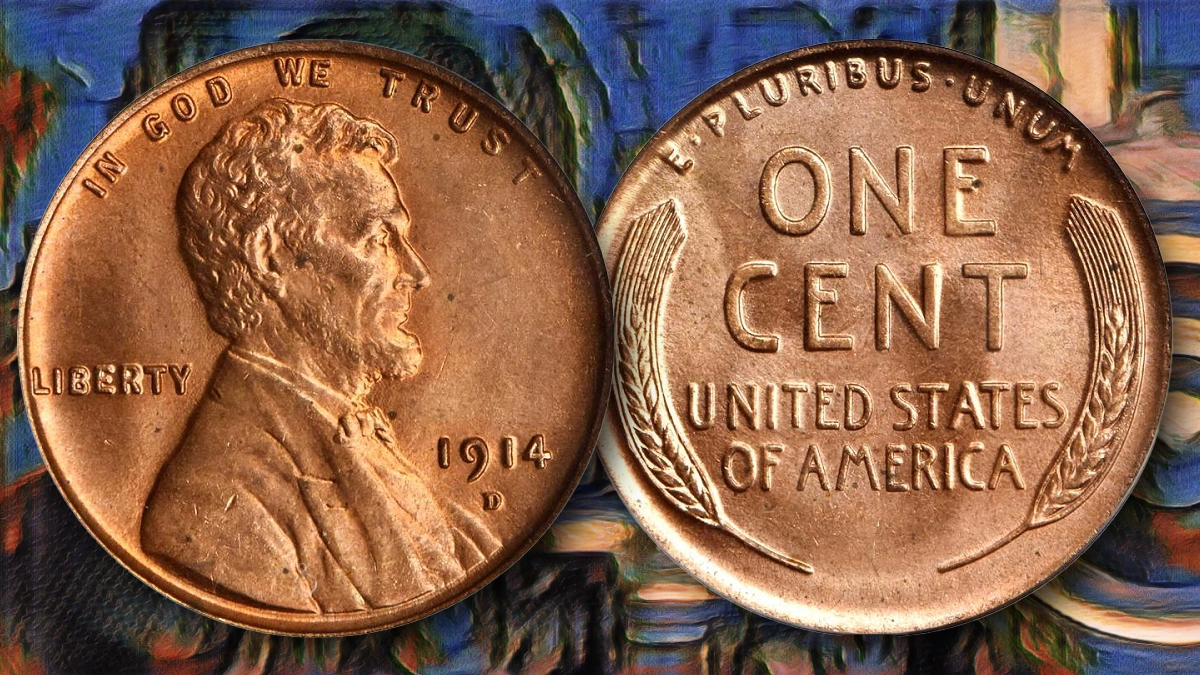
The 1914-D Lincoln Cent remains the key date of the early Lincoln Wheat cent series in Mint State. Collectors have pursued it for generations. At the same time, counterfeiters have targeted it just as aggressively.
Although the Denver Mint struck 1,193,000 examples, far fewer survive in high grade. Today, population data confirms that original Mint State Red coins remain rare. As a result, demand continues to center on certified examples with strong eye appeal and solid provenance.
Mintage and True Scarcity
The 1914-D mintage exceeds that of the 1909-S VDB Lincoln cent. However, census data shows that the 1914-D proves scarcer in Mint State.
To date:
- Just over 300 examples have been certified as Mint State Red.
- Approximately 600 examples appear in combined PCGS and NGC censuses in Mint State Red Brown.
Controversial numismatic writer Walter Breen once recounted that a New England dealer reportedly held 10 rolls of Mint State coins as late as 1943. Researchers should treat that anecdote cautiously unless independently verified.
In practical collecting terms, the 1914-D anchors the date-and-mintmark Wheat cent set. Specialists may pursue rarities such as the 1943 Copper or 1944 Steel cents. Nevertheless, the 1914-D defines the core series.
Counterfeit Detection: Essential Diagnostics
The 1914-D Lincoln cent ranks among the most counterfeited U.S. coins.
Counterfeiters often add a “D” mintmark to a 1914 Philadelphia cent. Others alter a 1944-D by reshaping the first “4” into a “1.” Therefore, authentication remains critical.
Collectors should confirm the following:
- Four known mintmark positions exist on genuine examples.
- One authentic die shows a small die crack extending from the rim at the right edge of Lincoln’s coat upward through the bust.
- Another authentic die displays a small tool mark curving down from the left serif of the “T” in LIBERTY.
- All genuine pieces show circular hub marks inside the “9” of the date.
- The 1914-D mintmark is smaller than the style used after 1931.
- Designer initials “VDB” do not appear on the bust truncation.
Professional certification strongly protects collectors in this segment of the market.
Top Certified Examples: Heritage, Stack’s Bowers, and GreatCollections
Rather than focus broadly on price trends, we highlight representative top-grade certified examples from major auction houses. These coins illustrate the quality collectors seek today.
Heritage Auctions
Heritage Auctions has handled several elite pieces:
- PCGS MS66 RD (Finest Known Tier)
Sold in 2016 for $81,075. According to the PCGS census, that coin ties with four others at the top grade level. - PCGS MS66 #48300148
- As PCGS MS65+RD CAC (#25279086), “PNG Invitational Signature,” October 9, 2014, Lot 4626 — $28,200
- May 3–7, 2023 — $52,800
- As PCGS MS66, “The Whispering Pines Collection,” January 16, 2025, Lot 4547 — $66,000
Ex: Bender Collection (as noted on label). Carbon spot below OF (reverse). Small constellation of spots around T in CENTS. - NGC MS66RD #175140-017
May 3–7, 2023 — $38,400. Die erosion visible above C and to the left of O (reverse).
Stack’s Bowers Galleries
Stack’s Bowers Galleries has also presented top-condition examples:
- NGC MS66RD #6045621-004
“Larry H. Miller Collection,” November 12, 2020, Lot 6017 — $38,400. Two copper spots near Lincoln’s forehead; green spot beneath right arm of T in CENT. - PCGS MS66RD #82620666
March 19, 2020, Lot 3108 — $40,800. - PCGS MS65+RD #33275322 (Revtyak Collection)
March 31, 2016, Lot 3021 — $17,625.
GreatCollections
GreatCollections has offered important CAC-approved coins:
- PCGS MS66RD CAC #1383394
“Stewart Blay’s Red Copper Collection of Lincoln Cents,” January 15, 2023, Lot 1272824. Old Green Holder. - PCGS MS65+RD #41273268
Sold March 21, 2021 (Lot 961616) and again April 2, 2023 (Lot 1309734, “Merritt Collection”). Numerous small copper spots noted. - PCGS MS65+RD #38093051
July 19, 2020, Lot 859650.
Current Top Population (As of 8/2025)
Population figures remain unchanged at all three major services since at least November 2024:
- PCGS MS66+RD: 1
- NGC MS66RD: 5
- CAC MS66RD: 1 (0 stickered / 1 graded)
These numbers reinforce the condition rarity that drives sustained collector interest.
Design and Specifications
Designer Victor David Brenner created both the obverse portrait of Abraham Lincoln and the Wheat reverse.
Specifications
- Country: United States
- Year: 1914
- Denomination: One Cent
- Mintmark: D (Denver)
- Mintage: 1,193,000
- Alloy: .950 copper, .050 tin and zinc
- Weight: 3.11 g
- Diameter: 19.00 mm
- Edge: Plain
- Quality: Business Strike
Final Assessment
The 1914-D Lincoln cent remains the defining key to the early Wheat cent series. Its modest mintage tells only part of the story. True scarcity appears in Mint State preservation.
Certified population data confirms the rarity. Auction records demonstrate sustained demand. Meanwhile, counterfeit activity underscores the need for expert authentication.
More than a century after striking, the 1914-D continues to test collectors’ knowledge and discipline. For serious Lincoln cent specialists, it remains essential.
Video Highlights
CoinWeek Editor Charles Morgan presents his take on why the 1914-D Lincoln Cent is the key to the early Lincoln series.
* * *




O my ill have to look at them again i think i have 2
It’s possible but unlikely, unless e.g. your coins were acquired a long time ago. Your best path would be to have them examined by an expert, especially as there are numerous counterfeits that were made by altering genuine 1944-D or 1914 (P) cents, among other ways.
My friend found a 1944 steal cent. Along with other wheat pennies that are without mint marks dates are before 1930s. Did he find something that could be worth alot of money? He found in an 100 yr. old farm house they were tearing down.
@SJ: You can run a few at-home tests before deciding you have a rare 1944 steel* cent. The first of course is to see if it sticks to a magnet. If not, it’s not made of steel. Second, weigh it. Steel cents average 2.7 grams while pre-1982 copper alloy cents come in at 3.11 gm.
If your coin passes both tests at home you’ll need to have it examined by a professional for posssible submission to a numismatic agency that can determine whether it’s real or counterfeit. For every genuine rarity among 1943 and 1944 cents there are a lot** more fakes.
(*) “Steel” of course
(**) “A lot”. Hope that helps :)
I have that penny
I have 2 steel penny
The rare steel cents are dated 1944. Over a _b_illion 1943 “steelies” were produced. In typical circulated condition they’re usually worth between 25¢ and a dollar.
Only 484,000 1909-S VDB cents were minted. Describing the 1914-D mintage of 1,193,000 as only “slightly more” seems IMO to be a be a bit of a stretch.
I have plenty of the wheat pennies
To the above comment, there are more or far more 1909-S VDB than 1914-D. Both are common but the 09-SVDB is more common, especially in MS.
The “slightly more” phrase was in reference to the coins’ original mintages which differ by more than a factor of two. However as you note, PCGS census estimates show significant skewing among survivors. While there are still a lot more estimated surviving 1914-D cents than 1909-S VDB (~120,000 versus ~50,000) overall, among those in MS-60 and above the latter predominate (~6,000 versus ~1,500). Arguably publicity around the 1909-S VDB cents probably led to a higher fraction being saved early on.
I stopped collecting coins after my father sold my 1792 half disme.He received $10,000 for it. I was 21 years of age. I would love to know when this coin is now. It was given to me by my grandmother who grew up in the Shrewsbury Massachusetts area. The coin is gone and so is my dad.
I’m so sorry to hear that. I do hope that you might come to enjoy collecting again soon.
Earlene
got one as well
@Jordan The article gives tips with some simple at-home checks you can do to rule out fakes. It’s important to check those points first, because as the story notes there are a lot of deceptive counterfeits. If your coin passes those straightforward tests it should be examined in person by a numismatic expert.
I have a 1923 wheat penny is it worth anything?
I have very faded version of this one penny
I found a 1914 D cent while coin roll hunting and had no idea what i had found until i did more research on it and realized what a hidden gem i had found.
Almost complete set, still looking for 1914D,
Love lincoln cents
“THE” Lincoln cent in my opinion then the 1909 S VDB.
Interesting article, i saw one where 4 was altered to a 1. only noticed alteration after coinshop owner pointed out pronounced space between the 9 and the 1.
Great article on the 1914-D Lincoln cent.
1 coin i still need for my collection